

The Secret of Contentment

The Secret to Contentment. Sermon by Pastor Andrew Marttinen, February 28, 2026
Contentment was not something most of us considered one week ago when the Canada Men’s Hockey team lost the game and lost a moment to cement immortality in sport. Instead one player missed a shot at an open net. It is metaphor of the things we miss getting into an empty net, creating an “if only” moment. Aesop’s fable of the fox and the grapes is like this moment.
One afternoon a fox was walking through the forest and spotted a bunch of grapes hanging from over a lofty branch. “Just the thing to quench my thirst,” said he. Taking a few steps back, the fox jumped and just missed the hanging grapes. Again the fox took a few steps back, ran, jumped, and tried to reach them but still failed. Finally giving up, the fox turned up his nose and said, “They’re probably sour anyway,” and proceeded to walk away. It is easy to despise what you cannot have. Aesop
Cognitive dissonance is the discomfort you feel when your actions and beliefs don’t match. It gives cause for rationalizing. Is it worth the effort fighting for something that has not personal value for you.
The widest river for us is the “If Only River”. This the widest river. “If only”. Are you at the banks of this river?
The frets and cares we have are often informed by events that happened to us when younger. Life today is busy. If we have stress, debt, long days this is all the ticket today to a good life. Is it?
To Paul the best life is much simpler. Life is informed by what we value.
Is religion valued? Why? Take your gifts and prayers, and add an adjective to describe them.
Be anxious for nothing, but in everything by prayer and supplication, with thanksgiving, let your requests be made known to God; and the peace of God, which surpasses all understanding, will guard your hearts and minds through Christ Jesus. Philippians 4:6,7
With thanksgiving. With gratitude. What mindset informs your frame of reference? Do you have a mindful awareness of the benefits of life. Are you aware of the benefits of gratitude? Gratitude can bring a healthy perspective to life. A healthy perspective can change the physical perspective. Gratitude leads us off the riverbank of If Only. Gratitude highlights curves around the hard rocks of “I should have…”, avoids the sands of “some time I’ll …, leads to the fertile valley of “all right”.
Gratitude brings blessings. The old hymn “Count Your Blessings One by One” was written long ago. It was the number two of most requested songs in revival meetings. It was written just before World War I in Victorian England.
Keep in mind that , while these strategies can make a bug difference, they do not replace professional help for serious sustained mental illness. It is a spiritual view point, not a medical one.
Paul wrote about his mindset despite being in jail, in very difficult circumstances he had no control over.
But I rejoiced in the Lord greatly that now at last your care for me has flourished again; though you surely did care, but you lacked opportunity. Not that I speak in regard to need, for I have learned in whatever state I am, to be content: I know how to be abased, and I know how to abound. Everywhere and in all things I have learned both to be full and to be hungry, both to abound and to suffer need. I can do all things through Christ who strengthens me. Philippians 4:10-13.
For to me, to live is Christ, and to die is gain. Philippians 1:21
Paul was focused on Christ. Paul expressed that no one could take away his joy.
The Two Pots

The Two Pots, Sermon by Pastor Andrew Marttinen, January 30, 2026.
Aesop’s tale of Two pots. Two Pots, one of brass and the other of clay, stood together on the hearthstone. One day the Brass Pot proposed to the Earthen Pot that they go out into the world together. But the Earthen Pot excused himself, saying that it would be wiser for him to stay in the corner by the fire. “It would take so little to break me,” he said. “You know how fragile I am. The least shock is sure to shatter me!” “Don’t let that keep you at home,” urged the Brass Pot. “I shall take very good care of you. If we should happen to meet anything hard I will step between and save you.” So the Earthen Pot at last consented, and the two set out side by side, jolting along on three stubby legs first to this side, then to that, and bumping into each other at every step. The Earthen Pot could not survive that sort of companionship very long. They had not gone ten paces before the Earthen Pot cracked, and at the next jolt he flew into a thousand pieces.
The moral of the story: if fairly happy, don’t ruin it by getting too close to power.
Christians focused on power at the expense of some values may find themselves discontented.
But there was a certain man called Simon, who previously practiced sorcery in the city and astonished the people of Samaria, claiming that he was someone great, to whom they all gave heed, from the least to the greatest, saying, “This man is the great power of God.” And they heeded him because he had astonished them with his sorceries for a long time. But when they believed Philip as he preached the things concerning the kingdom of God and the name of Jesus Christ, both men and women were baptized. Then Simon himself also believed; and when he was baptized he continued with Philip, and was amazed, seeing the miracles and signs which were done. Acts 8:9-13
This story of Simon is a cautionary tale of dangers of commercializing or monetizing the message of God. Simon wanted to be great in the eyes of the people, to use the Holy Spirit to manipulate people.
Paul had a very different motivation. His desire was to see the kingdom of God and testimony of Jesus.
But what things were gain to me, these I have counted loss for Christ. Yet indeed I also count all things loss for the excellence of the knowledge of Christ Jesus my Lord, for whom I have suffered the loss of all things, and count them as rubbish, that I may gain Christ and be found in Him, not having my own righteousness, which is from the law, but that which is through faith in Christ, the righteousness which is from God by faith; that I may know Him and the power of His resurrection, and the fellowship of His sufferings, being conformed to His death, if, by any means, I may attain to the resurrection from the dead. Philippians 3:7-11 NKJV
Righteousness through faith.
But now, because of the Chosen One, I have let go of those things in which I took so much pride. They now mean nothing to me. 8Even more than this, I now count all things to be worthless compared to the great beauty of knowing the Chosen One, Creator Sets Free (Jesus), as my Honored Chief. Because I follow him, I have lost everything, but compared to knowing the Chosen One, I now count them as dog droppings.
To be in full harmony with the Chosen One is my desire. I do not want to gain my own good standing with Creator by keeping tribal law but by trusting in the Chosen One. This good standing comes from the Great Spirit by trusting in what he has done, not what I can do. I want to fully know the Chosen One and the power that raised him from the dead. I want to know what it means to participate in his sufferings and to become like him in his death, living in the hope that, like the Chosen One, I will also rise from death to life. Philippians 3:7-11 (FVNT)
Simon wanted to gain all.
Paul wanted to give all. Paul gave up position to know Christ.
Daniel 2 is the story of Nebuchadnezzar’s dream of the image. The feet were made from clay and iron. A mix of iron and clay nations. Currents of life bring to light the things of life. Metal focuses on might and power and does not bring what is desired.
Rome made promises to weaker countries with regional conflicts. “We will help you and take care of local issues.” Then Rome refused to leave. “For security reasons, we need to stay”. This helped Rome to build an empire.
Do not put your trust in princes,
Nor in a son of man, in whom there is no help.
His spirit departs, he returns to his earth;
In that very day his plans perish.
5Happy is he who has the God of Jacob for his help,
Whose hope is in the Lord his God
Psalm 146:3-5
Edward Mote was born on January 21, 1797, in London, England. His parents managed a pub. Mote grew up completely unaware of God. He spent his time as a child laying in the streets, with no exposure to church or Scripture. But as he grew older, the grace of God began to work in his heart. He became an apprentice to a cabinetmaker and encountered the gospel of Jesus Christ. His Christian journey started as an older teenager. At age 50 he started to preach and became a minister of a Baptist church. It was while working as a cabinet maker that he started to work on a hymn that later became My Hope Is Built on Nothing Less, his nest known hymn. He experienced a life that was built on hope focused on Christ.
My hope is built on nothing less than Jesus’ blood and righteousness;
I dare not trust the sweetest frame, but wholly lean on Jesus’ name.
Refrain: On Christ, the solid Rock, I stand:
all other ground is sinking sand; all other ground is sinking sand.
When darkness veils his lovely face, I rest on his unchanging grace;
in every high and stormy gale, my anchor holds within the veil. [Refrain]
His oath, his covenant, his blood, support me in the whelming flood;
when all around my soul gives way, he then is all my hope and stay. [Refrain]
When he shall come with trumpet sound, O may I then in him be found:
dressed in his righteousness alone, faultless to stand before the throne. [Refrain]
God is Always in Control

January 24, 2026 God is Always in Contol. Sermon by Gerry Gibbs
God is always in control. God has a plan for us, that has been in motion for us.
Isaiah predicts the coming of the Messiah as is also foretold in other Bible books in the OT.
Conception of Christ is foretold. In the time of Abraham – there will be a time of a king.
God made a safe gap if we were to sin, having free will. A saviour was coming.
Luke 1”sall his name Jesus”
Mary said yes because she was close to God. Despite being worried and perhaps a bit scared.
Luke 2:8-14 The greatest thing to happen in man’s history. God made His move, not just a promise, not just a story. An actual baby who needed care by a mother.
Jesus was born a human being. Mary had to nurse her baby, clean her baby.
We don’t know a lot about Jesus as a child. We imagine Jesus did many of the things we have done as a child. As Jesus grew up he became a carpenter. Building things. Another young man. He lived close to God.
God mad e a decision when we would bring the Messiah into the world.
Satan and his disciples were shaking in their boots. Satan realized his time was limited, as he wanted to deceive people. Confusion even with religion. Satan’s plan to deceive and he will work harder and harder. God was telling his people I am in control. It was ingenius.
Favourite part of Christimas I like is Luke 4:23-25
Christ’s mission to love, heal, forgive sin.
Christ came to show the people what God’s character was all about. At this point in time, with idolatry, much of faith was incorrect, fearful. Taught to be scared of God. Throughout scripture, the Pharsiees and Saducees tend not to talk of God’s love, compassion. WhenJesus put mud on the blind man’s eyes, Jesus told them you are miossing the point of the law: goodness graciousness, mercy.
The woman bleeding fot 12 years. She felt all she had to t=do was touch his cloak t =o be healed. Jesus stopped. “Who touched me?” Touch of faith. This Jesus could heal her. First time in 12 years called daughter as abandoned by family for being unclean. Jesus showed compassion. He touched lepers. It touched people, and could see true character of God. Jesus turned God into something positive in a time portrayed as weapon of obedience, instead of love. Glorified their power, instead of God’s love. Jesus called on His father only to intervene for others. He looked to His heavenly Father to help others. He never asked fir the Father to intervene for Himself. He would go to God to talk to God for strength. This is such as example for us. Personal relationship so important. You are His child.
If Jesus needed this time, how much more do we need?
He knows we need a personal relationship with our Father day to day.
God celebrates with us during difficult times.
One time when Jesus went to pray by himself. This prayer Matt 26:36-46
The Garden of Gethsemane. He asked disciples to go with Him. One reason I believe to help us understand to not fall asleep, walk away from God. Hang on. People often leave because they are struggling with depression, anxiety and feel church is not helping. God says don’t fall asleep, don’t let it go away. That is whay ?Jesus went to Gethsemane. To vbe close ot His father.
Jesus could not go against His father’s will. That was His mission and he was not going to fail mankind. Jeus had to die. That was His fate for our salvation. He was the superioe lamb, THE sacrifice. People not born yet were covered by tis sacrifice. Jesus could not say no thot he salvation of mankind. Jesus is in control. Jesus was horribly crucified. He was crucified because he went against the religious peop;e at the time. Jeus’ death was art of the plan. Pleaded with His father. I have already did many mioracles and you still do not believe me.
So amamzing . One criminal mocked Him. One said I am yours. He did not understand totally, but he knew that Jesus had what he wanted. Jesus impressed [people while hangiong on the Cross. Then IT IS Finished. Buried in a tomb.
THE INCREDIBLE time.
John 20:13-17. Jesus rose from the dead. Because he rose we can believe everything God has writtem=n. No other example of this in humanity. If Christian did not rise, no Christianity. The stpry is part of the plan. God had to bring hom back to life to show us that we can live in Christ. We also die, and will rise after death. Without the risen Christ, christinanity would be nothing. He rose to reflect our rising, and recognizws what happens in baptism. Resurrection to a new life.
The second coming of Jesus :1 Thessalonians. We will live forever and live with God and Christ. Nothing to fear in death. Death is a sleep. When we open our eyes next, she will see her loved ones at the resurrection. You are with Jesus. One big family, to perfection. Love, joy, perfection. No more mental illness, fighting, etc. A perfection we cannot fathom. We know it will not be like it is here. The loved ones we have are chosen by God. I count all those today at this time. Do not be afraid of the judgment. We have nothing t worry about – joy and happiness. This is His plan, He is in control.
The Offering of Cain and Abel
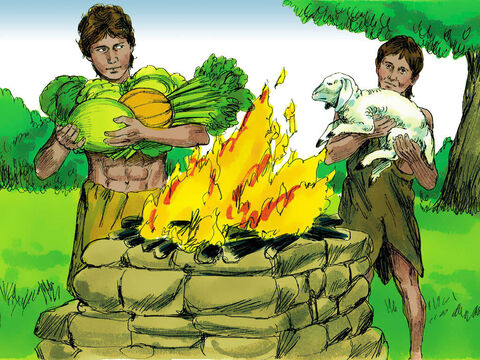
Photo from FreeBibleImages
Sermon The Offering of Cain and Abel, January 10, 2026.
We shall not cease from exploration
And the end of all our exploring
Will be to arrive where we started
And know the place for the first time.
T.S. Eliot, The Four Quartets
When exploring scripture you sometimes come across surprises. Things you were taught don’t
seem to jibe with what’s actually in the Bible. You may discover it for the first time. Somehow I
got the impression that the story of Cain and Abel began by God asking for a sacrifice of a lamb
rather than vegetables. Abel brought the lamb that God wanted while Cain, in a deliberate act of
defiance, thought he knew better than God and brought fruits and vegetables from his garden
as his sacrifice. I thought (or was taught) sometime in my life that the whole row between the
brothers was caused by Abel’s obedience and Cain’s disobedience of a plain command of God.
It turns out scripture records things differently.
Genesis 4:1-5 says:
Adam made love to his wife Eve, and she became pregnant and gave birth to Cain. She said, “With the help of the LORD I have brought forth a man.” Later she gave birth to his brother Abel.
Now Abel kept flocks, and Cain worked the soil. In the course of time Cain brought some of the
fruits of the soil as an offering to the LORD. And Abel also brought an offering—fat portions
from some of the firstborn of his flock. The LORD looked with favor on Abel and his offering, 5 but
on Cain and his offering he did not look with favor. So Cain was very angry, and his face was
downcast.
The text never says that God asked for an animal sacrifice. You don’t have to read it for yourself,
because I, as a trusted pastor, have just read it to you. No command here, just a non-judgmental
observation by the author of Genesis 4.
The idea of God requiring a blood sacrifice was probably put into my mind as sleeper cell
propaganda from someone wanting to promote some theory of atonement requiring blood.
Ostensibly the blood of Jesus. In other words, Cain rejected Christ’s sacrifice so bad things will
happen if you follow his example.
In actuality, if you look at Genesis 4:3-5 The story does not explain why the LORD had regard
for Abel and his offering but not for Cain and his offering. Instead it focuses on Cain’s reaction to
this unexplained divine preference for the sacrifice of the younger brother.
It is immediately followed by a dangerous question God asks of Cain in 6-7
Then the LORD said to Cain, “Why are you angry? Why is your face downcast? If you do what is
right, will you not be accepted? But if you do not do what is right, sin is crouching at your door; it
desires to have you, but you must rule over it.”
This is the first mention of sin in the Bible. It is depicted as a predatory animal, lurking at the
door.
You may or may not have heard of something called “Last Generation Theology.” It is hotly
debated in Adventist circles, but essentially it brings out ideas like perfect obedience, sinless
perfection and the role of a pure end-time church that hastens the Lord’s coming.
This is hotly debated because when it comes to perfection, whose definition of perfection are we
talking about? Relational perfection? The Wesleyan idea which spearheaded the Holiness
Movement is that perfection means being in a state of constantly maturing, coming to Christ
daily when we mess up. I might go along with this, but primarily the problem with LGT thinking is
a lot bigger than this: It emphasises what God asks rather than attitude.
How does this actually play out in scripture? What is God’s word on this matter?
When we think of God making us aware of our place in the universe, we often see it reflected in
an act of how we respond to Him. Offerings. Thankfulness.
When Jesus addresses offerings in The Sermon on the Mount–a loving response to God. He
may have had Cain and Abel in mind. It says “When you bring your sacrifice to the temple,
make things right with people before you give an offering there.”
23 “Therefore, if you are offering your gift at the altar and there remember that your brother or
sister has something against you, 24 leave your gift there in front of the altar. First go and be
reconciled to them; then come and offer your gift. Mat. 5:23
Even prayer falls into this category. James says prayers aren’t answered because they are not
prayed “in God’s will.”
When you ask, you do not receive, because you ask with wrong motives, that you may spend
what you get on your pleasures. James 4:3
It’s not offering the prayer but the motive of that offering. Attitude of Widow who gave 2 mites.
“He (Jesus) sat down opposite the treasury and observed how the crowd put money into
the treasury. Many rich people put in large sums. A poor widow also came and put in two
small coins worth a few cents. Calling his disciples to himself, he said to them, ‘Amen, I
say to you, this poor widow put in more than all the other contributors to the treasury.
For they have all contributed from their surplus wealth, but she, from her poverty, has
contributed all she had, her whole livelihood.’” Luke 21:1-4
Theologian Addison Wright observed this juxtaposition of the story.
The account of the Widow’s Mite is followed by, “As he was making his way out of the
temple area one of his disciples said to him, “Look, teacher, what stones and what buildings!” Jesus said to him, “Do you see these great buildings? There will not be one
stone left upon another that will not be thrown down.” Verses 5-6
What follows is Jesus’ end-times discourse. Attitude, it seems, is an apocalyptic issue here.
Wright notes the irony that as the Temple was destroyed in the year 70, the widow’s gift was not
only misguided, but for nothing. The physical temple didn’t survive, but the concept of
generosity survived reality. The spiritual precept still stands. Well, the widow’s mites may have
survived. Here are two that ended up in my collection of artifacts from bygone days.
I could cover the waterfront with Bible examples of attitude vs. what God asks. The parable of
the Pharisee & Publican comes to mind but I don’t have time to spend on that one. Suffice to
say, it’s our attitude and character that we take to heaven and the new earth–not a whole bunch
of stuff and a list of accomplishments. I have never seen a U-Haul come to the gravesite of a
funeral that I’ve conducted.
How can we put all of this together?
Lots of these incidents mention “The Temple.” Remember that in the context of our day, the
altar, temple, church etc. mean a Person–Jesus. This is the attitude of one who comes to Christ.
Can you see Jesus gathering up his 70 disciples one morning and saying “So what do you guys
want to do today?” No, the teachings of Scripture are more about attitude than what God wants
from us.
1 Tim. 3 lists what is required of people put into church positions. It is all about the character of
those serving the Lord. Not accomplishments, age or an impressive resume of tasks completed.
It’s about having the characteristics of a lamb rather than a wolf.
The Psalms have no “God told me to tell you” in them. Yet they are considered the highest level
of worship–communication between God and us.
What about the “last generation.” Last Generation Theology stresses some form of perfect
obedience, etc. I addressed “what is perfect” before. In Rev. 14 the 144,000 are pictured on the
holy mountain and are described as blameless. Using parallelism, the very next verse says that
“they followed the Lamb wherever He goes. Wesley defines perfection as meaning growth.
When my 2 year old granddaughter draws a flower, it is far from a perfect representation of the
real thing. However, she is blameless. Later on we may expect more, but while on this side of
the Jordan river, she will never draw a flawless one.
I respect the Holiness movement (Wesleyan churches), in which the goal is to (through grace)
grow into a life of perfect love. And I respect the Orthodox and Anglican theology of theosis,
that is, growing toward union with God (through grace). But these are not about sinlessness,
and they are not about having the right set of doctrinal statements. As soon as the
conversation becomes ABOUT sinlessness (ego-centered instead of God-centered), it is off
the rails and is headed in the opposite direction from perfect love and union with God. It
seems to me that when we are growing into love and union with God, we will not think to ask
the LGT question. –Comentator to an article about LGT in a recent Church magazine
One prominent minister preached this:
Rev. 12:11, which addresses the end-time people has the “Death Test.
It describes the ultimate ideal of the 144,000 in the end times.
They triumphed over him by the blood of the Lamb and by the word of their testimony;
they did not love their lives so much as to shrink from death.
Sinless perfection or attitude? He concludes his thought with:
It’s not just for the final generation but also the attitude we must have today. Be willing to die
rather than willfully, knowingly, sin against God. Inviting into your life the crouching Lion that
even the LORD said to Cain that even he can overcome. They triumphed over him, the beast that
crouches by the doorway, by the blood of the Lamb and by the word of their testimony.
William Ralph Featherston(e) Canada 1846-1873. Born in Montreal, Quebec, Canada, he joined the
Wesleyan Methodist Church there. He became a Christian at age 16 while in Toronto, and is thought to
have written his famous hymn about the same time. Right after giving his life to Christ, he composed
a poem, his response to someone’s testimony about Jesus. He sent the poem to his aunt, Ms. E.
Featherston Wilson and she gave it to a publisher. Adoniram. J Gordon, an evangelist, founder of
Gordon College & Gordon-Conwell Theological Seminary, found the hymn in a 1870 London hymnal
and was impressed with the words, but did not like the tune, so he composed the melody that has
been used with the hymn ever since. Featherstone is thought to have married Julie R MacAlister in
1869 and that they had a son, John, in 1870. Featherstone died in Montreal at age 26.
The Law Informed By Grace
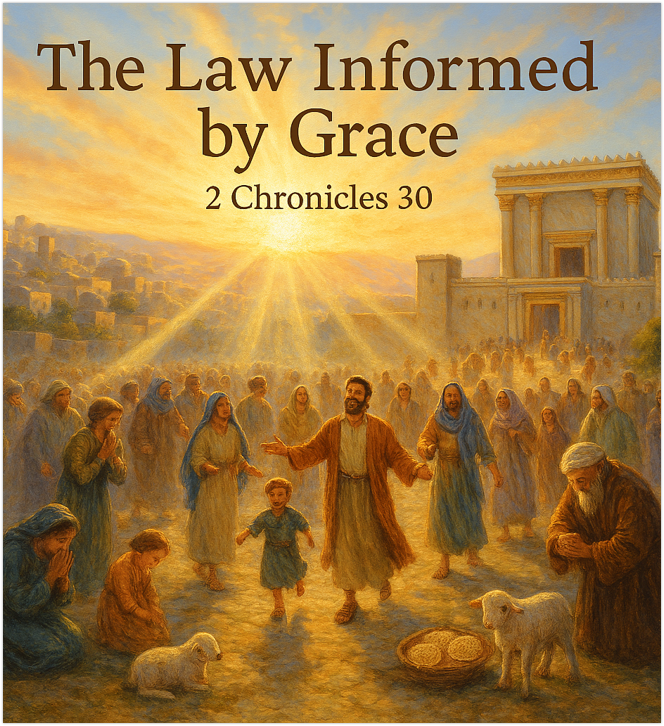
Photo by MS Copilot
Sermon The Law Informed By Grace by Arlene Lanting December 13, 2025
In this season we reflect on the love of a God that sends His son to save the sinner like you and me. In Him, love and grace abound. I am going to take you to the Old Testament today and talk about that grace and it’s relationship to the law.
We often view law and grace as opposing ends of a continuum. We discuss the law as a test of faith and grace as a gift. Two very different things. Is it possible we are looking at grace and law from a self-centred perspective?
We are going to look at Hezekiah’s story this morning in 2 Chronicles 29 and 30. In this story we see Hezekiah has a determination to restore Judah from a state of spiritual neglect. Judah has followed Isreal’s path with worship to idols and neglect of the worship of the Lord. Hezekiah sets out to guide Judah in a return to God, to cleanse the temple, to purify themselves, to prepare for worship. In the process he discovers that healing comes in stages, that law and grace are intertwined. Lets explore this journey, that ends in worship and celebration like Judah had not seen in a long time.
Before we begin, let’s take a quick look at some points of interest in the history of the kings of Israel and Judah. Hezekiah is a descendant of King David. There is some other interesting genealogy here. We also note that Hezekiah is an even closer descendant of King Omri, and therefore of King Ahab and Queen Jezebel, the most infamous king and queen duo in Israel. At the time of King Ahab’s reign in Israel, Jehoshaphat was king of Judah. Jehoshaphat sought an alliance with King Ahab, to strengthen their ability to defend themselves from neighbours seeking to expand their boundaries. Jehoshaphat’s son Jehoram married Ahab’s daughter Athaliah, who was every bit as evil as her mother. After King Jehoshaphat died, Jehoram became king. When he dies, his son Ahaziah became king. When Ahaziah dies, his mother Athaliah had all royal descendants destroyed, except for one of her grandsons, Jehoash, whose aunt hid him from Queen Athaliah. After Athaliah’s death, Jehoash became king. King Hezekiah is the great great great grandson of Jehoash. We can see the impact of decisions of King Hezekiah’s descendants that impacted the history of Israel and Judah.
Hezekiah was twenty-five years old when he became king, and he reigned in Jerusalem twenty-nine years. His mother’s name was Abijah daughter of Zechariah. He did what was right in the eyes of the Lord, just as his father David had done. 2 Chronicles 29:1,2
King Hezekiah sent word to all Israel and Judah, and he wrote letters of invitation to the people of Ephraim and Manasseh. 2 Chronicles 30:1
Hezekiah asked everyone to come to the Temple of the Lord at Jerusalem to celebrate the Passover of the Lord, the God of Israel.
“Children of Israel, return to the Lord God of Abraham, Isaac, and Israel; then He will return to the remnant of you who have escaped from the hand of the kings of Assyria. And do not be like your fathers and your brethren, who trespassed against the Lord God of their fathers, so that He gave them up to desolation, as you see. Now do not be stiff-necked, as your fathers were, but yield yourselves to the Lord; and enter His sanctuary, which He has sanctified forever, and serve the Lord your God, that the fierceness of His wrath may turn away from you. For if you return to the Lord, your brethren and your children will be treated with compassion by those who lead them captive, so that they may come back to this land; for the Lord your God is gracious and merciful, and will not turn His face from you if you return to Him.” So the runners passed from city to city through the country of Ephraim and Manasseh, as far as Zebulun; but they laughed at them and mocked them. 2 Chronicles 30:6-11
They believed that God had turned his face from them. We see throughout history that it is usually the opposite – it is the people who turn from God. We also see throughout history that God waits patiently for their return. Hezekiah was pleading with the people to let go their grievances with God. Their stiff necked stubbornness was hurting themselves. Pride keeps men from yielding themselves to the Lord; when that is brought down, we are able to see our anger is more related to how we have behaved than how God has. Unfortunately the king of Israel was not inclined to follow the Lord, however he did not dissuade people from attending Passover in Jerusalem. Conversely the order came to all those from Judah who responded with one heart, to worship the Lord.
“Pride keeps men from yielding themselves to the Lord; when that is brought down, the work is done.” Accordance by Matthew Henry
The plan for keeping the Passover seemed right to King Hezekiah and all the people. The people had not been celebrating it in great numbers as required in the Law. Now was the time. God’s hand was on the people in the land of Judah, giving them all one heart to obey the orders of the king and his officials, who were following the word of the Lord.
Lets take a closer look at clean and unclean. To prepare
They arose and took away the altars that were in Jerusalem, and they took away all the incense altars and cast them into the Brook Kidron. 2 Chronicles 30:13
On the fourteenth, one month later than usual, the people slaughtered the Passover lamb. This shamed the priests and Levites, so they purified themselves and brought burnt offerings to the Temple of the Lord. The insinuation here is that not all of the priests and the Levites were in one accord, committed to this celebration. Some of the people who were to lead the celebration were not committed until the people started to prepare. Then they pitched in and helped to start the celebration themselves.
These leaders were humbled. Have you ever known church leaders who have dug their heals in because they are so sure they know better about what is right? Beware – because older and younger and in the middle people can do the same thing in an attempt to prove their point. In this case the leaders, the priests and Levites involved were humbled and stepped up to serve. They took their places at the Temple as prescribed in the Law of Moses, the man of God. The Levites brought the sacrificial blood to the priests, who then sprinkled it on the altar.
Since many of the people had not purified themselves, the Levites had to slaughter their Passover lamb for them, to set them apart for the Lord. Since many of the people had not purified themselves, the Levites had to slaughter their Passover lamb for them, to set them apart for the Lord.
Most of those who came from Ephraim, Manasseh, Issachar, and Zebulun had not purified themselves. But King Hezekiah prayed for them, and they were allowed to eat the Passover meal anyway, even though this was contrary to the requirements of the Law. For Hezekiah said, “May the Lord, who is good, pardon those who decide to follow the Lord, the God of their ancestors, even though they are not properly cleansed for the ceremony.” 2 Chronicles 30:18, 19
What does it mean in the Bible to be clean and unclean? Lets look at a small sample of Mosaic law, both related to the Passover and general laws of clean and unclean and purity. Lets look at a small sample of Mosaic law, both related to the Passover and general laws of clean and unclean and purity.
Examples of clean:
- Festival of unleavened bread
- Israelites would eat unleavened bread for 7 days
- Day 1 was the ritual of removal of leaven from the home
- This ritual symbolized the removal of sin and corruption, preparation for spiritual readiness
- It represented the casting away of iniquities, spiritual idolatries
2. Cleansing of the temple:
- The priests would clean the temple
- Only the priests could do this.
3. Personal Purification:
- Physical cleanliness
- Represents preparation and the nature of worship
- Represents redemption
Examples of unclean:
- Unfit things to use or do in preparation for worship to God
- Animals that are acceptable to sacrifice
- Not touching a dead body
- Bathing and hygiene
- These are examples that differentiate between holy and common
- Represents approaching God with reverence
The principle of being clean and unclean crosses into the New Testament as well, with the idea of living spiritually pure and seeking to be holy, living a life worthy of our calling. Jesus used the idea of being “clean” to speak of being holy.
“Now then, you Pharisees clean the outside of the cup and dish, but inside you are full of greed and wickedness. You foolish people! Did not the one who made the outside make the inside also? But now as for what is inside you–be generous to the poor, and everything will be clean for you.”
Luke 11:39–41
Purity in worship in 1 Cor 5 which speaks about immorality in the church.
In John 2 Jesus went up to Jerusalem. In the temple courts he found people selling cattle, sheep (etc.) including exchanging money. He made his disappointment at this disregard for the cleanliness of worship.
When we get caught up in the letter of the law, we may miss the essence of the law, if so then we miss the whole point. Yes it is about preparation to worship God, about spiritual purity, but if we focus primarily on personal purity we fail to recognize the specialness of worship and how that affects our relationship with others. We get into so much trouble when we just focus on ourselves!!! Clean and unclean in relation to worship represented the specialness, readiness, and holiness of worship. In it’s core it is not actually about our holiness, but Gods. We have a tendency to personalize it.
Let’s go back to 2 Chr 30:18, 19.
Since many of the people had not purified themselves, the Levites had to slaughter their Passover lamb for them, to set them apart for the Lord.
… And King Hezekiah prayed for them, and they were allowed to eat the Passover meal anyway.
And the Lord listened to Hezekiah’s prayer and healed the people. And they were accepted. So the children of Israel who were present at Jerusalem then kept the Feast of Unleavened Bread seven days with great gladness; and the Levites and the priests praised the Lord day by day, singing to the Lord, accompanied by loud instruments. Hezekiah encouraged all the Levites regarding the skill they displayed as they served the Lord. The celebration continued for seven days. Peace offerings were sacrificed, and the people gave thanks to the Lord, the God of their ancestors. 2 Chronicles 30:20 -22
When the ceremony was done, the people did not want to stop celebrating. So they continued the festival another seven days.
The entire assembly of Judah rejoiced, including the priests, the Levites, all who came from the land of Israel, the foreigners who came to the festival, and all those who lived in Judah. There was great joy in the city, for Jerusalem had not seen a celebration like this one since the days of Solomon, King David’s son. Then the priests and Levites stood and blessed the people, and God heard their prayer from his holy dwelling in heaven. 2 Chronicles 30:25-27
This story does not suggest we should not follow God’s laws, even Hezekiah understood that. Rather it is about God’s grace. For those who may not have it all right, but desire in their heart to serve Him, Hezekiah understood he could not reject them for being unclean. And God did not disagree. God’s love is shown most vividly in His grace. Grace and love are linked. I remember in another church a long time ago, 2 children came to church from the community after having come to VBS. They had foul mouths. Some parents wanted///// Perhaps we do not know, at times like this, what we should do. Let us focus on the joy of those who are learning about God and desire to know God’s love. They need to grow in their time, not ours.
The people in Hezekiah’s time, clean and unclean, celebrated and joy abounded as they worshipped the Passover and celebrated the feast of unleavened bread. It was a celebration of a life time! A celebration that these families would remember for years to come. A celebration of worship, joy and healing. This story informs us that grace informs the law. Grace brings immeasurable joy!!
How does this relate to us in our modern era?
“Had we always emphasized this vital necessity for the grace of Christ in our public presentation of the message, the charge of legalism would not have arisen.” J.A. McMillan, Law and Grace, Ministry Magazine May 1963
The religiously inclined profess to love God and who endeavor to fit themselves for heaven by painstakingly observing the letter of the law. McMillan describes these Christians as foreigners to the grace of God. They are intent on weaving a robe of self-righteousness with which to cover their inner sense of sin. Pride of self is really at the root of this kind of religious philosophy. Cloaked as they may, sin keeps breaking out.
Of such was the Pharisee who “prayed thus: ‘I thank thee, 0 God, that I am not like the rest of men, greedy, dishonest, adulterous; or, for that matter, like this tax-gatherer. I fast twice a week; I pay tithes on all that I get’ ” Luke 18:11,12
This man felt no need for grace. He was a self-made saint and he worshiped his creator.
“Grace means favor to one who is undeserving, to one who is lost.” The SDA Commentary, EG White Comments Ephesians 4:7
The apostle enumerates in Romans a list of things “the law could not do”.
The law can:
- expose sin but can not atone for sin
- define righteousness but can not bestow it
- point the way to life but can not give life
All these things the law could not do, because it is law. Grace, however, can. We are not under law as a way of life, but are under grace as a way of life. There is a big difference between the two when we separate them however – It’s not law and then grace. It’ not law or grace. It’s grace and law.
“There are those who profess to serve God, while they rely upon their own efforts to obey His law, to form a right character, and secure salvation. Their hearts are not moved by any deep sense of the lore of Christ, but they seek to perform the duties of the Christian life as that which God requires of them in order to gain heaven. Such religion is worth nothing”. Steps to Christ pg 44
“What a loss it is to the soul who understands the strong claims of the law, and who yet fails to understand the grace of Christ which doth much more abound.” Selected Messages Book 1 p. 156
We cannot work our way into heaven, we cannot buy our way in, we cannot eat our way in. Yet some give the impression that they are doing this very thing. Why is this legalism not only wrong, but also disastrous?
“Without the grace of Christ it is impossible to take one step in obedience to the law of God. Then how necessary that the sinner hear of the love and power of his Redeemer and Friend! While the ambassador for Christ should plainly declare the claims of the law, he should make it understood that none can be justified without the atoning sacrifice of Christ” Selected Messages Book 1 p. 372
There is nothing wrong with the law – with good food, giving to the work of the church or striving to live a good life – as long as we understand that it is grace that is the why. When we forget the why, we do for ourselves and forget about our mission. Our mission is not about us, but about sharing God’s love with others!!
“We owe everything to grace, free grace, sovereign grace. Grace in the covenant ordained our adoption. Grace in the Saviour effected our redemption, our regeneration, and our adoption to heirship with Christ. Let this grace be revealed to others.” Testimonies, vol. 6, p. 268.
Had we always emphasized this vital necessity for the grace of Christ in our public presentation of the message, the charge of legalism would not have arisen. When the law of God is presented, not from Mount Sinai but from Mount Calvary, legalism goes by the board. J. A. McMillan
“Even the moral law fails of its purpose, unless it is understood in its relation to the Saviour”. The Desire of Ages p. 608
Jesus said to him, “‘You shall love the Lord your God with all your heart, with all your soul, and with all your mind.’ This is the first and great commandment. And the second is like it: ‘You shall love your neighbor as yourself.’ On these two commandments hang all the Law and the Prophets.” Matthew 22:37-40
When we strictly follow the law and don’t the understand why, we focus on our journey at the expense or disregard of others. And how Christian is that?
But God, who is rich in mercy, because of His great love with which He loved us, even when we were dead in trespasses, made us alive together with Christ (by grace you have been saved), and raised us up together, and made us sit together in the heavenly places in Christ Jesus, that in the ages to come He might show the exceeding riches of His grace in His kindness toward us in Christ Jesus. For by grace you have been saved through faith, and that not of yourselves; it is the gift of God, not of works, lest anyone should boast. For we are His workmanship, created in Christ Jesus for good works, which God prepared beforehand that we should walk in them. Ephesians 2:4-9
The law shows us a path that is informed by grace but sometimes we are so focused on ourselves we forget the why. Hezekiah understood that when he allowed those who were unclean to partake in the Passover and eat the Passover feast, despite what the law said, that God deemed it more important to accept those who were eager to serve Him, than to follow the letter of the law at the expense of those that did not know the law. Hezekiah understood righteousness is not what we achieve but what God has given us, as an extension we are meant to share this wondrous gift. In this season when so many people reflect or at a minimum sing songs of Christ’s birth, it is about more than just a baby. It is about God’s grace that saves us. We need to think less of ourselves and more of Christ, and as an extension, more about others.
For God so loved the world that He gave His only begotten Son, that whoever believes in Him should not perish but have everlasting life. For God did not send His Son into the world to condemn the world, but that the world through Him might be saved. John 3:16,17
Listen to these words of the hymn Come Thou Long Expected Jesus written in 1744 By Charles Wesley.
Come, thou long expected Jesus!
born to set thy people free;
from our fears and sins release us,
let us find our rest in thee.
Israel’s strength and consolation,
hope of all the earth thou art;
dear desire of every nation,
joy of every longing heart.
Born thy people to deliver,
born a child and yet a King,
born to reign in us forever,
now thy gracious kingdom bring.
By thine own eternal spirit
rule in all our hearts alone;
by thine all sufficient merit,
raise us to thy glorious throne.
______________
-
Faith
Sermon Faith by Pastor Andrew Marttinen December 6, 20264 Luke 5:18-20 18 Some men came carrying a paralyzed man on a mat and tried to take him into the house to lay him before Jesus. 19 When they could not find a way to do this because of the crowd, they went up on the…